


This is Week 3 of a series inviting you to zoom out to see the bigger picture of Scripture.
Yellow paint beams off the corrugated metal tunnel leading into Craighead Caverns. This tunnel serves as both the main entrance and exit to the Lost Sea Adventure—a cave attraction near Interstate 75 in Sweetwater, Tennessee.
After more than an hour exploring the cave’s dark depths and vast underground lake, the bright paint prepares your pupils for the blaring East Tennessee sun waiting outside.
Light is offensive to the dark. Stepping into it can feel blinding at first.
This can also describe the process of entering the light of Jesus.
Salvation is instant.
Sanctification is progressive.
Like a newborn learning to focus, those who are born again spiritually don’t always see clearly all at once (John 3).
This theme of progressive understanding runs throughout the Gospel of Mark.
Mark can be divided into two major sections.
The first eight chapters document Jesus’ ministry around Galilee.
The final eight trace His march to Jerusalem and the Passion.
Peter’s confession that Jesus is the Christ (Mark 8:29) is often treated as the bridge between these two sections.
But just before that confession, Mark records a rare miracle—found only in his Gospel—that helps us zoom out and see a bigger picture.
The Only Miracle Done in Stages
The miracle recorded in Mark 8:22–26 is the only miracle Jesus performs in stages.
A group of people bring a blind man to Jesus and beg Him to heal him. Jesus leads the man out of the village, spits on his eyes, lays hands on him, and then asks:
“Do you see anything?” —Mark 8:23
Jesus never asks questions because He lacks information.
The man responds: “I see people, but they look like trees, walking.” —Mark 8:24
Jesus lays His hands on him again.
And the man sees clearly.
Not just clearly—radiantly.
Mark 8:25 is the only verse in Scripture that uses the Greek word télaugós, meaning shining, radiant, bright.
One lexicon notes that the word was commonly used in military and navigational settings to describe objects visible in broad daylight.
As one commentary notes …
What the sun does for eyesight, the Son does for insight.
If you read this miracle in isolation, it could leave you confused.
Why heal in stages?
Why two touches?
To understand that, you have to zoom out.
This Miracle Isn’t About the Blind Man
It’s about the disciples.
Mark 8 opens with Jesus feeding 4,000 people using what amounts to a first-century Lunchable.
Immediately afterward, the Pharisees demand another sign. Jesus refuses—not because He can’t perform miracles, but because He won’t cater to unbelief.
Soon after, the disciples board a boat and realize they forgot bread.
Jesus uses this as a teaching moment:
“Watch out; beware of the leaven of the Pharisees and the leaven of Herod.” —Mark 8:15
He’s speaking about the corrupting influence of sin and hypocrisy—using bread as the analogy—right after miraculously multiplying it.
And the lesson sails straight over the disciples’ heads.
Instead of listening to Jesus, the disciples listen to their stomachs.
They panic over one missing loaf, right after watching the Bread of Life feed thousands.
So Jesus presses them with prophetic language from Ezekiel and Jeremiah:
“Having eyes do you not see, and having ears do you not hear? And do you not remember?” —Mark 8:18
This sets up — and explains — the twice-touched blind man in the middle of Mark 8.
Confession Without Clarity
But there is still more to see.
Next comes Peter’s famous confession: “Jesus is the Christ.”
This is the climax of the first half of Mark’s Gospel.
The turning point.
The moment that signals the march to the cross.
Surely now the disciples see clearly.
Nope.
Moments later, Jesus explains that He must suffer.
Peter rebukes Him.
Jesus responds: “Get behind me, Satan.”
Even after confessing the truth, Peter still doesn’t fully see.
But Peter is about to witness something very few humans ever have.
He is about to see a blinding light—the radiance of God’s glory.
Light From the Son
Mark 9 records the Mount of Transfiguration.
Jesus takes Peter, James, and John up a high mountain and gives them a preview of His glory.
Mark writes that Jesus was: “transfigured… radiant, intensely white, as no one on earth could bleach them.” —Mark 9:3
This isn’t light shining on Jesus.
It’s light shining from Him.
This is the Son whose glory will make the sun unnecessary in heaven (Revelation 21:23).
Then Moses and Elijah appear—the Law and the Prophets—fulfilled.
And Peter makes another mistake.
In trembling fear, he offers to build three tents, unintentionally equating Jesus with Moses and Elijah.
God the Father interrupts: “This is my beloved Son; listen to him.” —Mark 9:7
Peter is rebuked—again.
Seeing Comes in Stages
Peter messed up.
More than once.
The disciples walked with Jesus, wore the dust of His sandals, and still didn’t see clearly.
Sound familiar?
Spiritual sight often comes in stages—just as physical sight does.
I can tell you that I first believed in Jesus when I was nine years old at Oak Grove Baptist Church in Madisonville, Tennessee — not far from the Lost Sea and that yellow tunnel. I was a tour guide there in high school, and I led many people up that bright pathway. But my life drifted toward darkness.
My vision blurred.
I still knew Jesus—but you couldn’t see it in my life.
It wasn’t until my thirties that my sight slowly returned.
Maybe I just drifted from God. The Bible warns against that (Hebrews 2).
Or—like the blind man at Bethsaida—did my sight just come in stages?
There is one thing I do know for sure.
“Twas blind, but now I see.”
Tears still well up in these half-blind eyes every time I hear those words in the old hymn “Amazing Grace.”
Mountain Mover
Years later, Peter reflected on his experience on the Mount of Transfiguration.
“We were eyewitnesses of his majesty… we ourselves heard this very voice borne from heaven, for we were with him on the holy mountain.” —2 Peter 1:16–18
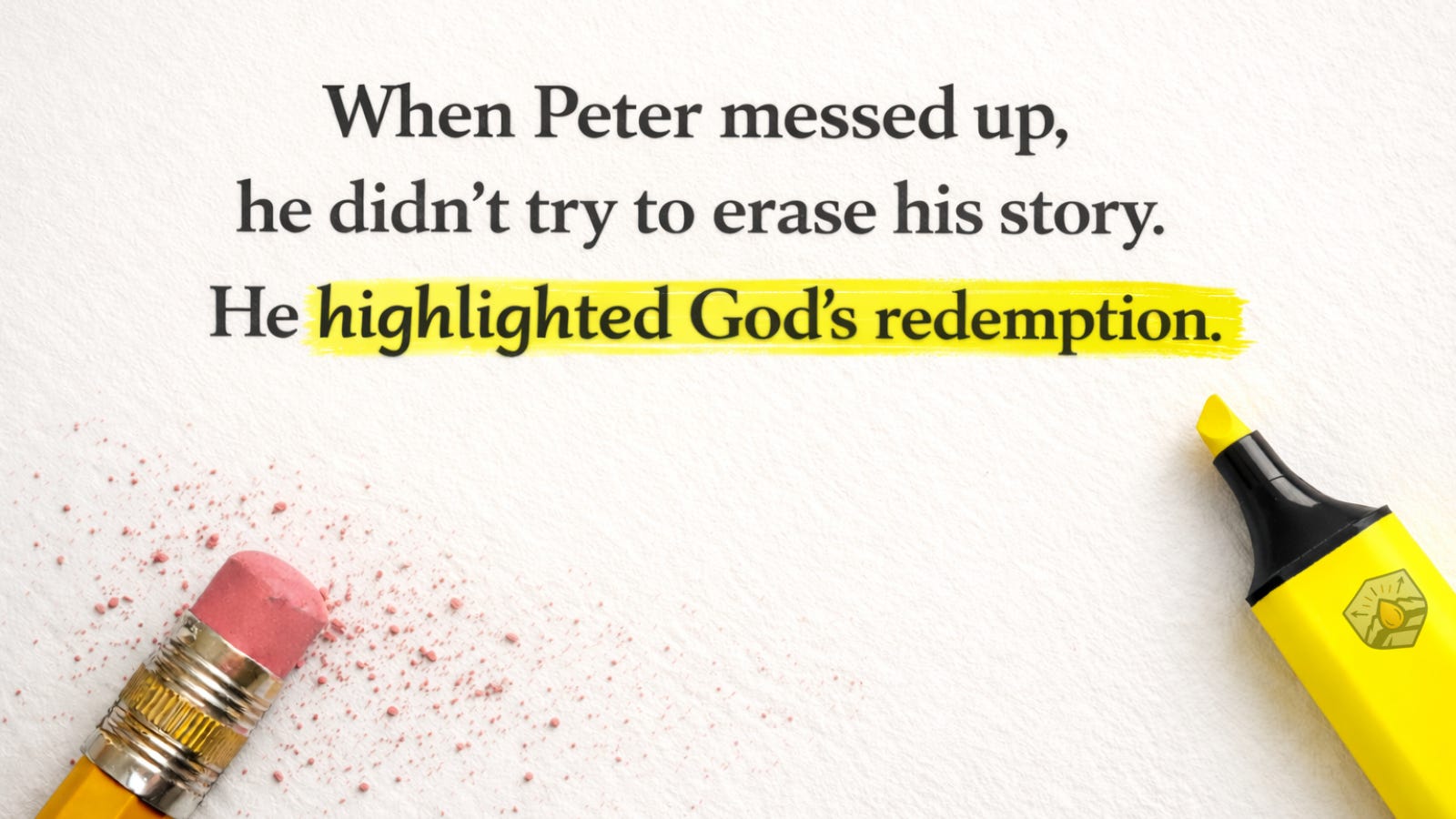
Peter didn't try to erase his mistakes. He highlighted God's redemption.
Apologetics calls this the criterion of embarrassment.
Peter admitting his failures gives credibility to his testimony.
It would have been easy for Peter to erase these details.
Tradition holds that Peter was the primary source of Mark’s gospel.
Yet Peter doesn’t grab the eraser. He reaches for the highlighter.
God often uses broken people as gospel torches to spread His light.
How you can you use your story to help this blind world see His radiant glory?
—
Operation Mustard Seed
New article every Tuesday
—
The Suffer Up Podcast is available with a new episode each Monday on all platforms.
I've read this understanding about the two stages of healing the blind man some years ago, the first stage is how the disciples see, the second how they will see. And that it forms a divide. This is not commonly taught nor thought, I found :(
Makes sense to me :)