

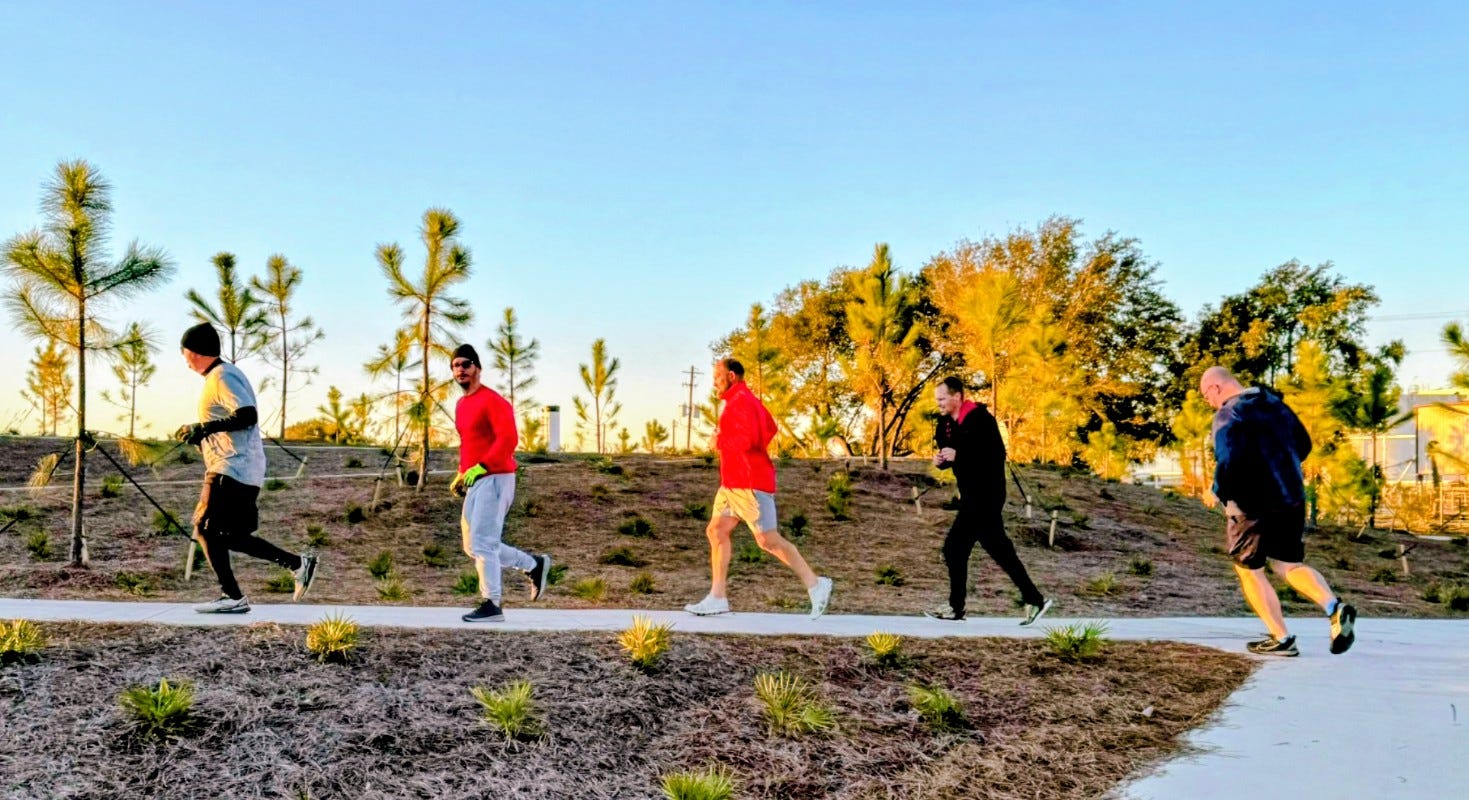
It’s 5:30 a.m.
Ten men of various ages and fitness levels have forsaken sleep for exercise in a middle school parking lot. They call it F3—Fitness, Fellowship, and Faith.
The group worked through 74-second intervals of different exercises to celebrate the birthday of the eldest man — a 74-year-old Navy vet and cancer survivor.
The workout ended with a run. I tried to be ambitious and follow the stronger guys for a longer distance, but I started to fall back.
Then, a guy I’ve never met turned around and ran beside me. His presence pushed me to the finish line.
This is part of the F3 culture called, “Picking up the six.”
The phrase, popularized in the military, uses a 12-hour clock face as a directional grid—with 12 o’clock straight ahead and 6 o’clock directly behind you.
In F3, the straggler is “The Six.”
I was The Six.
Picking up the six is not simply a matter of courtesy. It’s how the team keeps charging toward 12 o’clock.
The straggler eventually becomes stronger, then he advances forward.
When a new straggler shows up, he goes back to get him.
It becomes a cycle of push and pull that advances the collective body forward, giving life to the F3 credo:
“Leave no man behind, but leave no man where you found him.”
A Call to Action
God has a similar call to action for us.
In Isaiah 58, God responds to His rebellious people who complain that their prayers during fasts are not being heard.
God didn’t need to hear. He could see their hearts.
Their fasting was a fake veneer aimed at keeping them at the head of the pack while neglecting the weak.
Caring for the homeless, hungry, naked, and needy would put their faith into action. And God promises that when they do:
“Your righteousness shall go before you; the glory of the Lord shall be your rear guard.” — Isaiah 58:8
This is the second time Isaiah uses the term “rear guard” to emphasize God’s protective presence (the other being Isaiah 52:12, regarding Israel’s return from exile).
The rear guard is the same concept as The Six. It designates the vulnerable position in the back of a formation prone to blind spots and sneak attacks.
The “rear guard” in Isaiah is not just a military metaphor.
We serve a God of action.
The rear guard echoed a key moment as Israel marched through the Red Sea with their Egyptian captors hot on their six:
“Then the angel of God who was going before the host of Israel moved and went behind them, and the pillar of cloud moved from before them and stood behind them.” — Exodus 14:19
A few chapters later, Israel faces its first battlefield test when Amalek attacks them in Exodus 17.
Deuteronomy 25 recounts the battle and adds a key detail — these desert raiders “cut off your tail, those lagging behind you.”
It was a sneak attack from the rear.
It seemed like Israel would be routed, but God’s protection prevailed. The freshly freed slaves defeated Amalek and built an altar to proclaim Jehovah Nissi—The Lord is my banner.
Banners typically went before armies, but God showed He had The Six covered, too.
Raising the Standard of Jehovah Nissi

Learn more about the battle against Amalek and how the banner of Jehovah Nissi points to Christ.
Get in the Action
How do we pick up The Six in our daily lives?
First, we must realize that we were worse than stragglers when God picked us up. Sin left us dead in our trespasses (Ephesians 2:1).
In Isaiah 58:8, God tells Israel that when they begin to uplift the weak, “your righteousness shall go before you.”
But we have no righteousness to offer apart from Christ (Romans 3:10).
Jesus gave His righteousness to us through His substitutionary sacrifice on the cross. This is imputed righteousness.
Picture the father placing a royal robe around his filthy prodigal son—a beautiful symbol of restoration and grace (Luke 15:22).
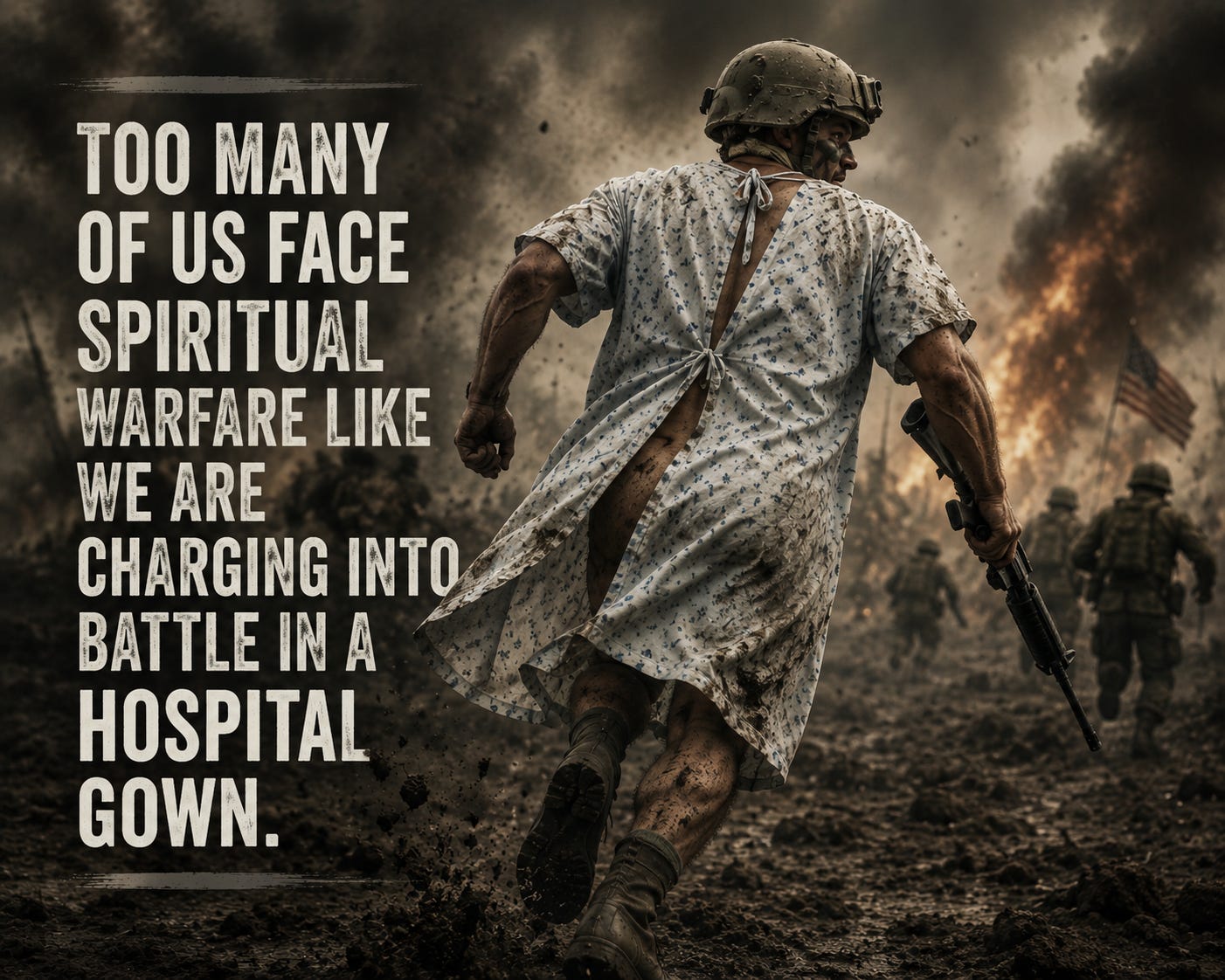
Jesus clothes us in His righteousness, yet we often refuse to wear it. Instead, we fight spiritual battles like we are wearing a hospital gown of shame.
Relics from our past are some of the enemy’s favorite weapons. When we allow failure, regret, and shame to paralyze us, we lose sight of God’s full presence.
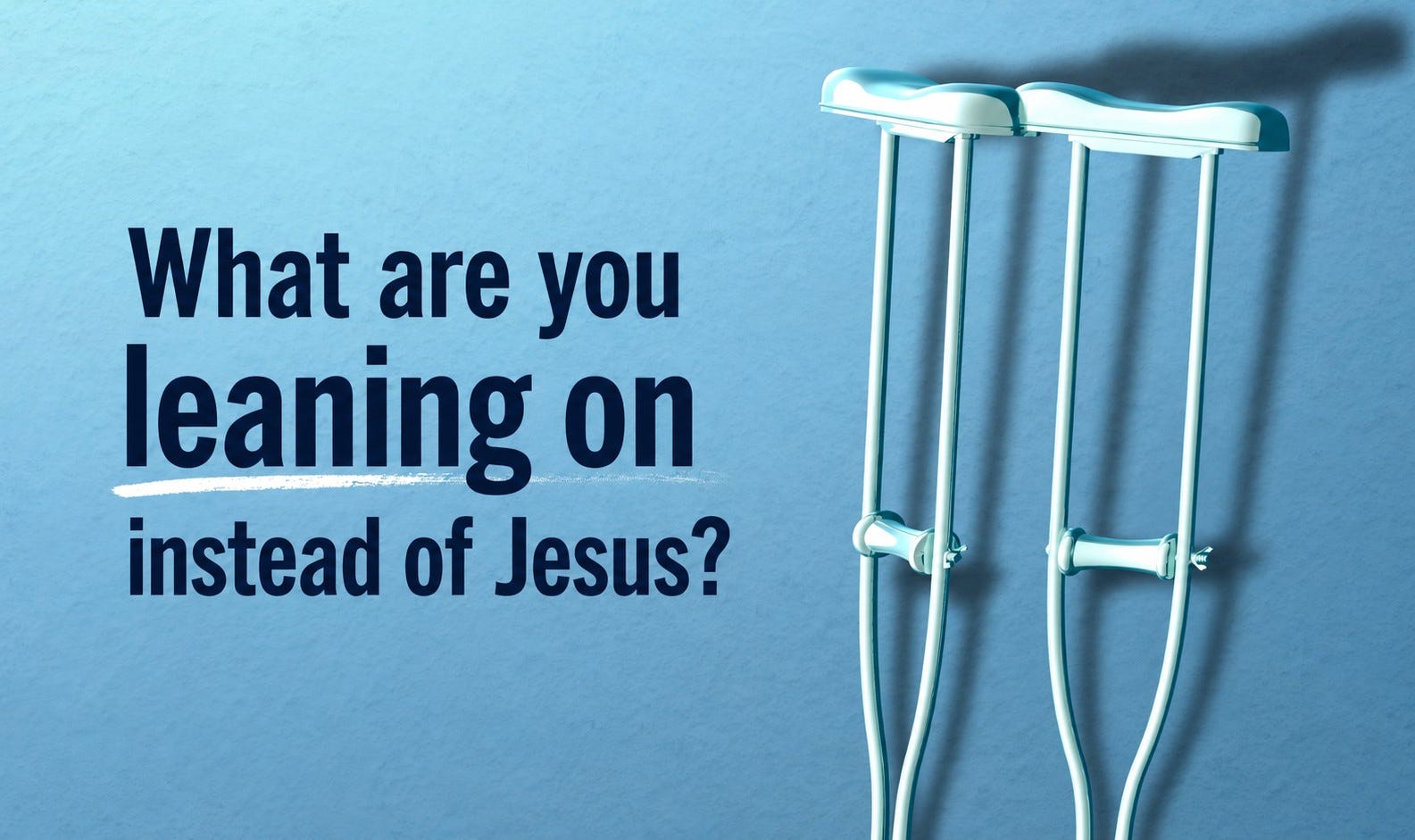
Those past mistakes can become a crutch. So can shallow religion. Just as God warned Israel that their fasting carried false intentions, we can fall into the trap of merely acting righteous.
We can even resent The Six.
Remember, the prodigal wasn't the only son. The older brother questioned why his brother deserved that robe when he had worked so hard. Self-righteousness was his crutch.
People on crutches don't walk fast. Whatever you lean on other than Jesus will slow you down and eventually make it impossible to pick up anyone else's Six.
When you allow the weight of God's Word to snap those crutches, “then shall your light break forth like the dawn, and your healing shall spring up speedily.” — Isaiah 58:8
Our past mistakes never dictate God’s future for us.
In fact, the mistakes behind you are often the very thing God uses to deploy you forward.
Paul told Timothy that he was the “foremost” of sinners:
“But I received mercy for this reason, that in me, as the foremost, Jesus Christ might display his perfect patience as an example to those who were to believe in him for eternal life.” — 1 Timothy 1:16
I feel like that foremost sinner a lot of days.
I question how I could sense a calling to ministry when I know the mistakes behind me.
I am The Six.
But God’s righteousness is before us.
And the glory of the Lord is our rear guard.
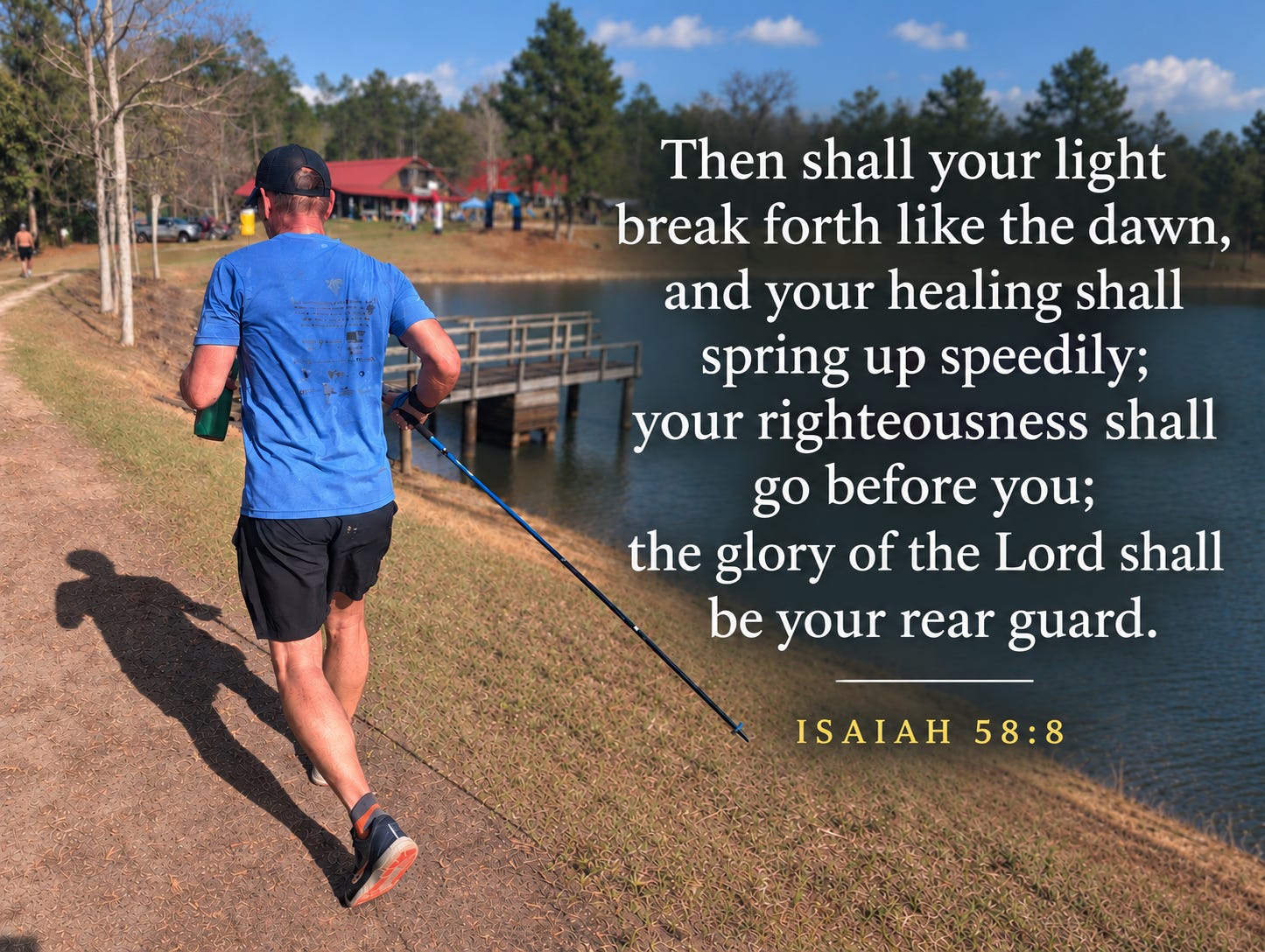
This photo was taken in February at the Punch Out Ultra, sponsored by the Suffer Up Podcast. Our team was made up of members of a men’s small group that meets each week for exercise, Bible study, and prayer.
They are the first Muster Seeds.
Click below for information on planting your own Muster Seed group.
Muster Seeds

Muster Seeds are open-source discipleship guides combining physical training, Scripture, discussion, and prayer. Like a mustard seed, they are small—designed to help men gather, grow, and go.
Follow our friends at the Suffer Up Podcast, whose mission is to encourage and lead others to suffer with a purpose. They strive to help others level up in life with an emphasis on spiritual, mental and physical wellbeing.