

Muster Seeds are open-source discipleship guides combining physical training, Scripture, discussion, and prayer. Like a mustard seed, they are small—designed to help men gather, grow, and go.
The Format: A simple, 60-minute blueprint—30 minutes of exercise, 30 minutes of study, prayer, and coffee.
The Location: Run them in churches, backyards, local parks, or wherever you can muster.
The Set-Up: Adapt them, scale them, and share them.
Have feedback? Contact us at info@musterseed.com.
1. Rally the Troops
In military units, a guidon flag serves as a visual reminder of identity, mission, and belonging. It literally means “guide of men.” Militaries would fly these banners to rally troops fighting on smoke-blanketed battlefields. Today, they guide marching troops. This workout reinforces that principle by repeatedly returning to the flag before moving back into the field.
Find a flagpole in a local park, bring a team flag, or create your own guidon.
Designate the flag as your rally point.
Establish multiple exercise stations around the flag (upper body, lower body, core, cardio, etc.). Designate them as battle stations.
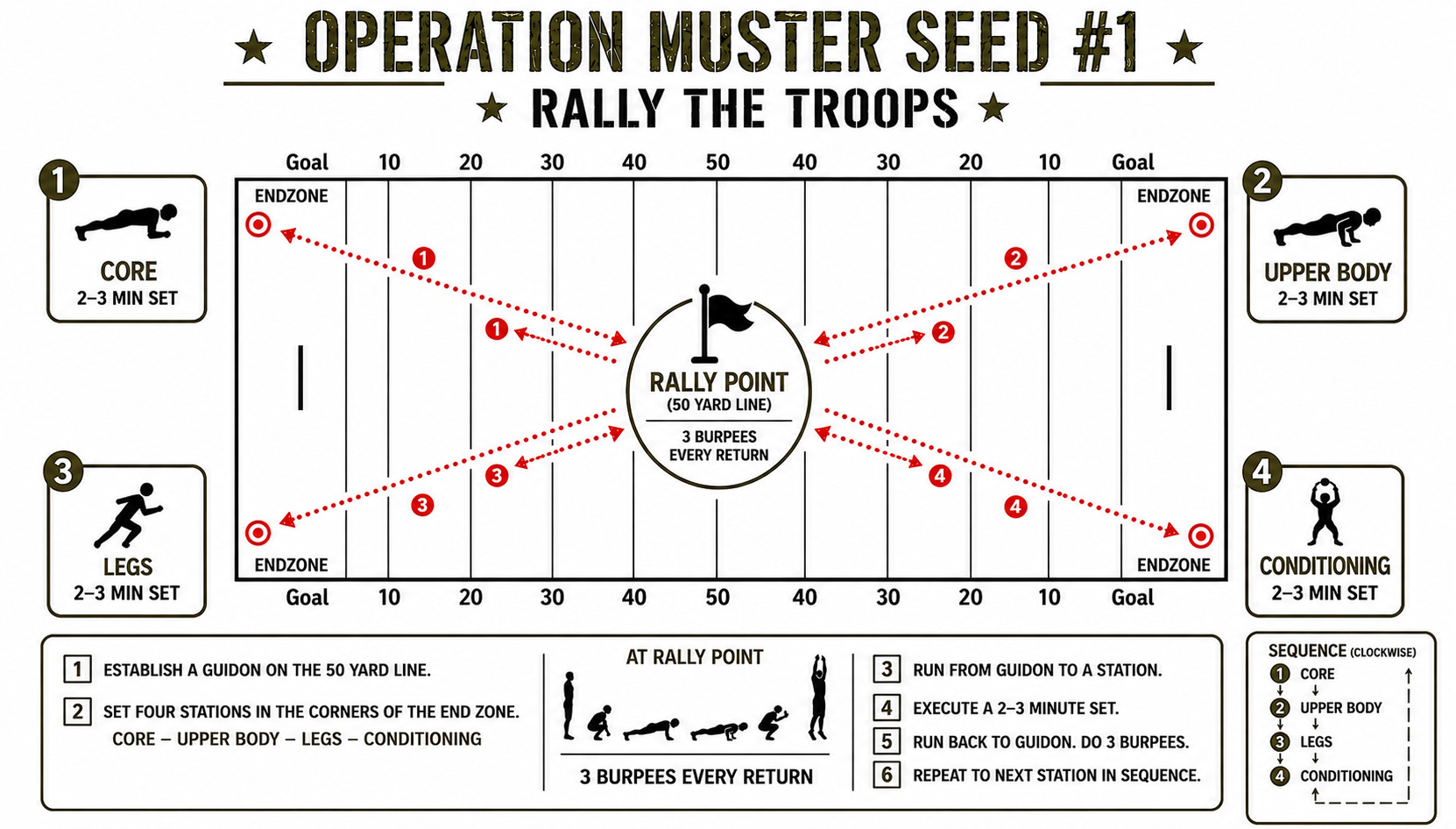
Space stations at varying distances to encourage movement between locations. You could place it on the 50 yard line of a football field, and run to the corners of the end zones. Or you could put it in a park and set four stations in any direction.
Simply move to one of the battle stations, complete a circuit for 2-3 minutes, then sprint back to the guidon. Touch the flag. Add a couple burpees if you want to up the challenge, and then move to the next battle station.
This diagram will help you set up the workout:
Discussion Questions
Remember, the guidon is a key symbol of unit identity.
If someone asked you, “Who are you?” how would you answer? Where is your identity anchored when everything else is stripped away?
Can you identify a season of life when you drifted from your purpose or identity in Christ?
How are you intentionally helping your children, family, or younger believers stand firm against those same pressures?
Scripture
Exodus 17:15, Numbers 21:8, John 3:14. Read this study to build your plan.

2. Walk the Line
Jeremiah 12:5 asks a powerful question:
“If you have raced with men on foot and they have worn you out, how can you compete with horses?”
Before God prepares us for greater challenges, He often tests our faithfulness in smaller ones. This workout develops discipline, endurance, and unity by requiring the group to move forward together—one step at a time. This is illustrated through a FOD Walk — Foreign Object Debris. This is the same method used on Navy aircraft carriers to ensure small debris does not damage aircraft. One bolt can take down a fighter jet before it gets on mission. This workout shows the power of unity to sweep our lives clear of the same debris.
Establish a starting line and finish line. A basketball court works exceptionally well, but any training area will suffice.
Line up all participants shoulder-to-shoulder across the baseline.
Move across the court as a single unit while maintaining a straight line. No one advances ahead of the group.
Round 1: The Initial Sweep
Take one step forward.
Perform one push-up. Get up.
Take another step forward.
Perform one push-up.
Continue the pattern until the entire line reaches the opposite baseline.
The Launch
The moment the line reaches the far side, immediately transition into a full-speed run for a designated distance or lap.
Subsequent Rounds
Repeat the movement pattern using different exercises:
Walking Lunges
Air Squats
Bear Crawls
Mountain Climbers
Broad Jumps
Maintain the line throughout each round before launching into the sprint.
Discussion Questions
Identify your footmen. What small battles are currently draining your strength? Consider recurring distractions, compromises, temptations, and discouragements.
Where has God already proven faithful in your life? Where can you see victories already won?
Where have you seen another man in your group gain ground? Encouragement authorized.
Scripture
Consider this study on Jeremiah 12.

3. Throw Your Weight Around
Cast all your anxiety on Him because He cares for you. — 1 Peter 5:7
Peter wasn’t telling fishing stories. This isn’t a call to gently cast and reel in. Peter says we show throw, hurl, and aggressively toss our burdens to God to keep from allowing self-control to grow into pride.
What better way to illustrate that than to throw a heavy ball around for 30 minutes (or more).
Find one medicine ball. Heck, use your kid’s dodge ball if that’s all you have.
As a team, take turns throwing it down field. Add an exercise where it lands to scale up. Switch throwing techniques at each round — overhead, rotational, backward toss. Add a goal or target to hit each round. This is easy to adapt for times when there are big sporting events — The World Cup, Super Bowl, etc.
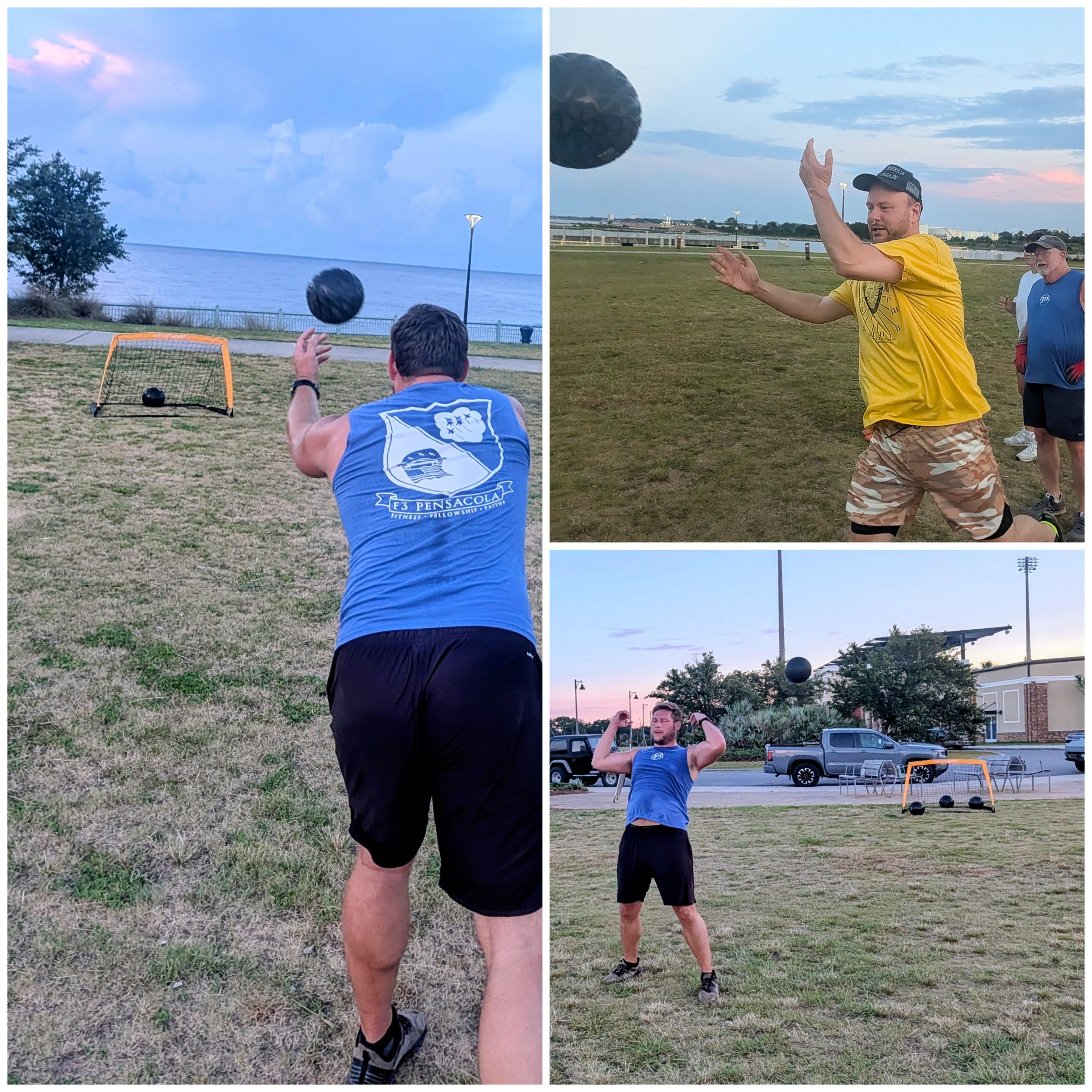
Men’s Health even recommended this workout:
https://www.menshealth.com/fitness/a19529810/medicine-ball-outdoor-workout/
Discussion Questions
What specific weight or struggle do you desperately need to mentally and spiritually “cast off?”
What is one thing in your life right now that you are deeply grateful to God for? What is another? Keep that specific momentum going this week by starting a daily gratitude journal.
Scripture
Read 1 Peter 5:6-7 and Luke 19:35. Compare the physical act of throwing at Palm Sunday with the spiritual act of casting your cares to God. Use this as a guide:

Peter’s famous New Testament exhortation to cast our cares entirely upon God was inspired by Psalm 55. Also read this passage together with your group. You could even do two weeks in a row around this format.
4. Number Your Days
“So teach us to number our days that we may gain a heart of wisdom. Return, O Lord! How long? Have pity on your servants! Satisfy us in the morning with your steadfast love, that we may rejoice and be glad all our days.” — Psalm 90:12–14
We all receive the same 24 hours each day and 7 days each week. The question isn’t how much time we have—it’s how we use it.
A traditional Tabata uses 20 seconds of work followed by 10 seconds of rest. Today we’ll switch it to 24 seconds of work and 7 seconds of rest as a reminder to live every 24/7 for God’s glory.
Complete 8 rounds (about four minutes total), alternating between two exercises.
Example
24 seconds: Push-ups
7 seconds: Rest
24 seconds: Squats
7 seconds: Rest
Repeat until you’ve completed all eight rounds.
Teaching Connection
The unusual 24/7 interval is intentional.
Most people spend their lives 24/7 chasing success, comfort, entertainment, or security. Moses reminds us that every hour is a gift from God.
The work intervals remind us that our days are limited and should be lived with purpose. The rest intervals remind us that our strength doesn’t ultimately come from ourselves but from the Lord.
Psalm 90 teaches us to number our days, seek a heart of wisdom, and begin every morning seeking satisfaction in God’s steadfast love. A life centered on Christ isn’t just about making the most of our time—it’s about living every day for the One who gave us that time.
Discussion Questions
If you truly believed your days were numbered, what would you spend more time doing? What would you spend less time doing?
Where do you need God’s wisdom right now instead of relying on your own understanding?
Moses prayed, “Satisfy us in the morning with your steadfast love.” What usually captures your attention first each morning before you seek God?
What do the last seven days of your life reveal about what matters most to you?
Scripture

5. Keep Building | Nehemiah (6-week series)
A. HIIT the Wall
High-Intensity Interval Training (HIIT) works by alternating quick bursts of maximum effort with brief periods of rest, creating a more efficient cardiovascular and metabolic response.
For this workout, use a wall to your advantage. If you have a tall wall (such as the side of a building), perform wall sits during your rest periods. Wall sits are a highly effective isometric exercise that builds lower-body endurance. To perform one, press your back flat against a wall, slide down into an "invisible chair" position with your knees and hips bent at 90-degree angles, and hold.
Use 20–30 second wall sits to lower your heart rate before your next run or a high intensity circuit. Repeat the cycle for the duration of your HIIT session.
If you have a shorter wall, incorporate step-ups, incline push-ups, and dips into your HIIT session.
Discussion
What convictions has God placed on your heart? How long have you felt this conviction?
What role does prayer play in your life’s construction projects? Is it the cement that holds everything together or merely an afterthought?
Where do you want to be three months from now? Six months? One year?
Study:

B. Ripple Effect
Water Option – Take the team (or families) to a pool and swim a few laps. Be sure lifeguards are present or that all appropriate safety guidelines are followed. This can also provide a natural opportunity to discuss baptism.
Land Option – Run in expanding circles. Start with a lap around the 20-yard line of a football field, then around midfield, and finally around the entire field. Mix in exercise stations between laps. Finish with a larger perimeter lap around the outside of the field. For a bonus round, have the team form a single-file line. The person at the back sprints to the front, setting the pace until the next runner repeats the process.
Discussion
How did Nehemiah use his influence to advance God’s kingdom?
Has God ever come up in a casual conversation at work or outside a church setting? How did it happen? Are you comfortable talking about your faith with others?
Who is one person in your circle of influence that you want to pray for as you seek an opportunity to share your faith?
Study

C. Shoulder-to-Shoulder
This is a partner-based workout. One partner performs the designated exercise while the other runs 50–100 yards. When the runner returns, switch roles. Continue alternating until you reach the team’s combined repetition goal.
Set ambitious totals—100 push-ups, 100 squats, 100 sit-ups—or take on a partner-style Murph. While one partner runs 100 yards, the other chips away at 100 pull-ups, 200 push-ups, and 300 air squats. Keep swapping until the entire workout is complete.
The point isn’t speed—it’s shared burden. Big tasks become achievable when they’re carried shoulder to shoulder.
Discussion:
What are some of the mundane, unglamorous aspects of your daily routine or job? How could you use them to build for God?
Do you serve in the local church right now? Why or why not? What could you do to support the local body?
In what practical ways are you actively opening doors for the people in your life (family, coworkers, neighbors) to discover Jesus? Where do you currently need help or backup?
What specific walls or boundaries do you desperately need to build up or reinforce in your personal life right now?
Study

D. Yards After Contact (YAC)
This week’s workout is Ultimate Frisbee. Ultimate Frisbee is a non-contact, self-officiated team sport where two teams pass a Frisbee to score points in opposing end zones. The core rules are that you cannot run with the disc, any incomplete pass is a turnover, and players manage their own fouls. Swap the Frisbee for a football if you want to make it Ultimate Football.
Discussion:
In football, YAC measures how many yards a player gains after being hit. Where in your life do you feel you've taken the hardest hits recently? How have you responded?
Nehemiah faced a lot of efforts to get him to stop the building project. What distractions, criticisms, or fears most often tempt you to "come down off the wall"?
Nehemiah responded to opposition with raw, honest prayer before taking action. Is there a situation you’ve been trying to handle on your own instead of bringing honestly before God? Is there someone you've struggled to forgive or pray for? What would it look like to entrust that person to God this week instead of carrying the burden yourself?
Study

Brilliant on the Basics
Nothing fancy needed. Don’t reinvent the wheel. Build with the basics.
Complete 4 rounds, running 1 lap (400m or whatever you designate) after each set:
5 push-ups, 5 squats, 5 crunches, then run one designated lap.
10 push-ups, 10 squats, 10 crunches, then run one lap.
15 push-ups, 15 squats, 15 crunches, then run one lap.
20 push-ups, 20 squats, 20 crunches, then run one lap.
Discussion
Why is biblical community essential to the Christian life? What keeps you connected to this group?
What is one faithful habit in your daily life that doesn’t need reinventing?
What is one practical way you can strengthen your local church this week through your time, talents, or resources?
Study

F. Absolute Failure
Nehemiah 13 ends with cracks in the wall, but it points to the Cornerstone. This workout will bring you to absolute failure, forcing that same reliance.
AMRAP (As Many Rounds as Possible) There will be five blocks of exercise, each five minutes long. During each five-minute block, perform as many rounds of this countdown as you can:
5 Push-ups
4 Crunches
3 Squats
2 Dips
1 Burpee
Rest for 60 seconds between blocks. Repeat the loop 5 times total. Keep track with a whiteboard, poker chips, chalk, or other method.
Discussion
What are some "cracks in the wall" in your own life or spiritual journey that point to your need for Christ as the cornerstone?
What specific "brick" or lesson from this study challenged your current daily habits or spiritual priorities the most?
Study

6. Keep Moving
Set up two stations at least 50 yards apart. If possible, place one station at the bottom of a steep hill and the other at the top.
At Station 1, decrease the reps each round. At Station 2, increase them.
Example:
Station 1: Push-ups — 20 / 15 / 10 / 5
Station 2: Squats — 5 / 10 / 15 / 20
Complete the reps at Station 1, move to Station 2, complete the reps there, and keep moving back and forth until all the pain is unpacked.
Mix and match exercises to create different combinations:
Sit-ups + mountain climbers
Jumping jacks + flutter kicks
Lunges + push-ups
Burpees + air squats
The point: Keep moving. The work may change, the terrain may change, and the location may change—but you keep moving forward.
Discussion
Ask every person in your group where their hometown is. How many are from the area you are in, and how many have moved. Ask those who have moved to new cities about their experience getting settled in a new home.
God told Israel to seek the welfare of their home. Establish roots. How do we improve the welfare of our city in a God-honoring way?
We often read Jeremiah 29:11 as a promise of personal prosperity. What did “prosperity” actually look like for Israel in exile? How might that reshape the way we understand God’s plans for our own lives?
Christians are described as “sojourners and exiles” in 1 Peter 2:11. How does that change your view on your citizenship and your role as a Christian?
Study
Read Jeremiah 29 and 1 Peter 2:11. A personal devotional on this material is located here:

7. Gut Check
The ancient Greek word splagchnizomai represents a deep, visceral, gut-wrenching compassion.
It is the exact word used when the father runs to meet the returning prodigal son in Luke 15:20.
It describes the Good Samaritan stopping for the dying man along Jericho Road in Luke 10:33.
And in Matthew 18, it marks the king’s sudden wave of pity toward a servant buried in insurmountable debt.
Before diving into that parable, spend 30 minutes working through this physical gut check to anchor the spiritual truth through movement.
Complete 5 Rounds:
30-second plank
20 Sit-ups
15 Flutter kicks
10 Standing crunches
5 Push-ups (or burpees, if you are an animal)
DISCUSSION
“And out of pity for him, the master of that servant released him and forgave him the debt.” — Matthew 18:27
Is your initial gut instinct usually compassion or anger when someone wrongs you?
How does remembering the insurmountable debt God has forgiven you reframe the debt someone else owes you?
What is one practical way you can extend active mercy this week to someone who has wronged you?
Study
8. COMPLETELY FORGIVEN
Read Matthew 18:21–22
Jesus answers Peter to completely forgive your brother vertically because we have been completely forgiven horizontally. He uses the number seven which is associated in the Bible with completion.
Meditate on that during this ~30-minute challenge.
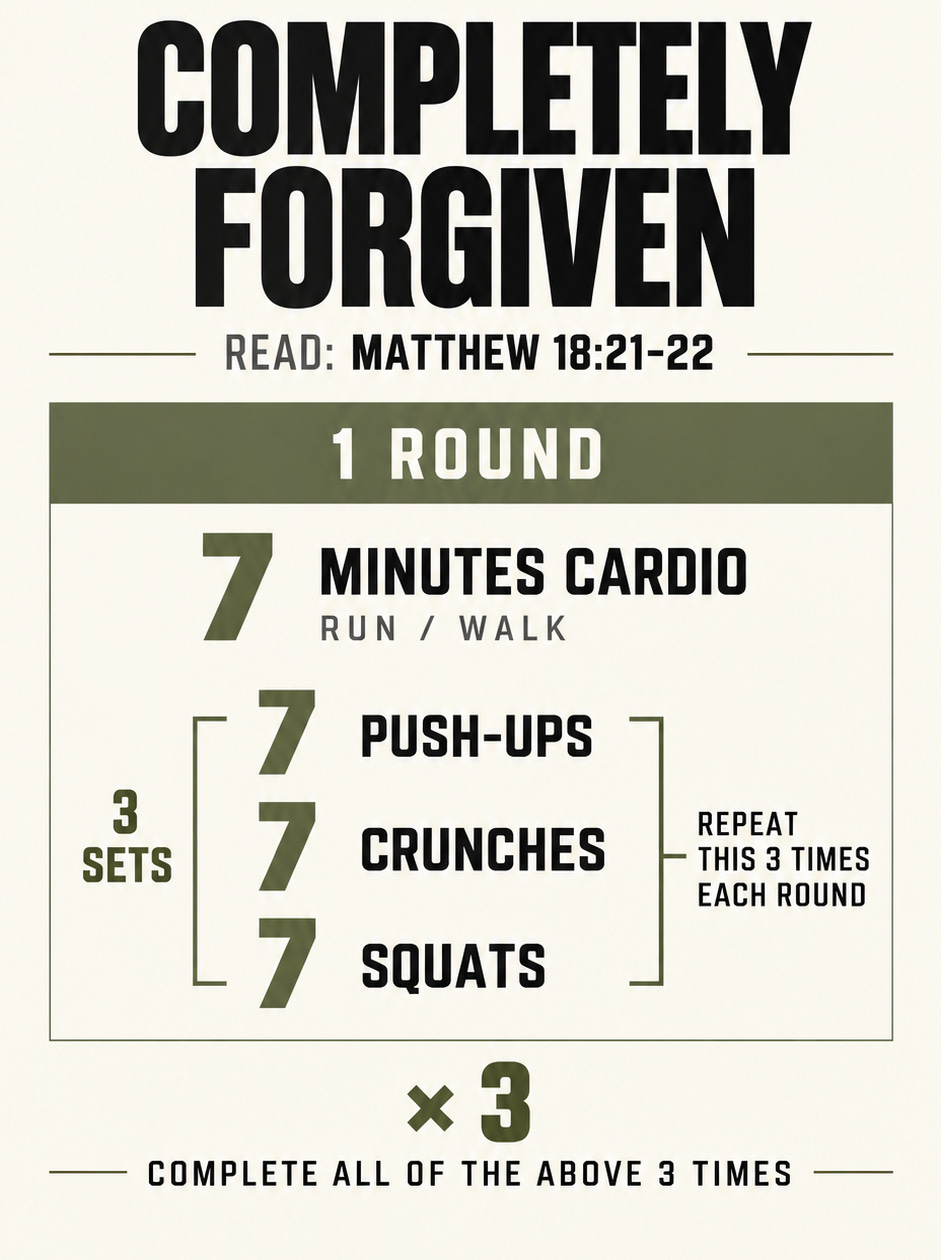
3 ROUNDS
7-minute cardio (run/walk)
7 push-ups / 7 crunches / 7 squats
7 push-ups / 7 crunches / 7 squats
7 push-ups / 7 crunches / 7 squats
One round = 7 minutes + the three 7/7/7 lines. Complete all of that 3 times.
PLAYLIST ADD-INS
“Sevens” — Brandon Lake
“Seven Nation Army” — The White Stripes
“Seven Bridges Road” — Eagles
Discuss
How does remembering your complete forgiveness by God help you completely forgive others who have wronged you?
READ
This passage is followed by the Parable of the Unforgiving Servant. Here is a full article and another Muster Seed:
Forgiveness from the Gut

The Parable of the Unforgiving Servant in Matthew 18 epitomizes why forgiven people should be forgiving people.
9. Pick Up the Six
Build around this classic team run before studying Isaiah 58.
Run in a single-file line, with the person at the back sprinting to the front while everyone rotates through the lead. When the last man reaches the front, he yells, “Next Man Up,” alerting the new man in the back to sprint forward.
Between sets of these runs, add other team exercises—pushups, crunches, squats, etc.
If you can find a six-pound medicine ball like the one pictured below, use it to emphasize the theme of the “rear guard” and picking up the six.
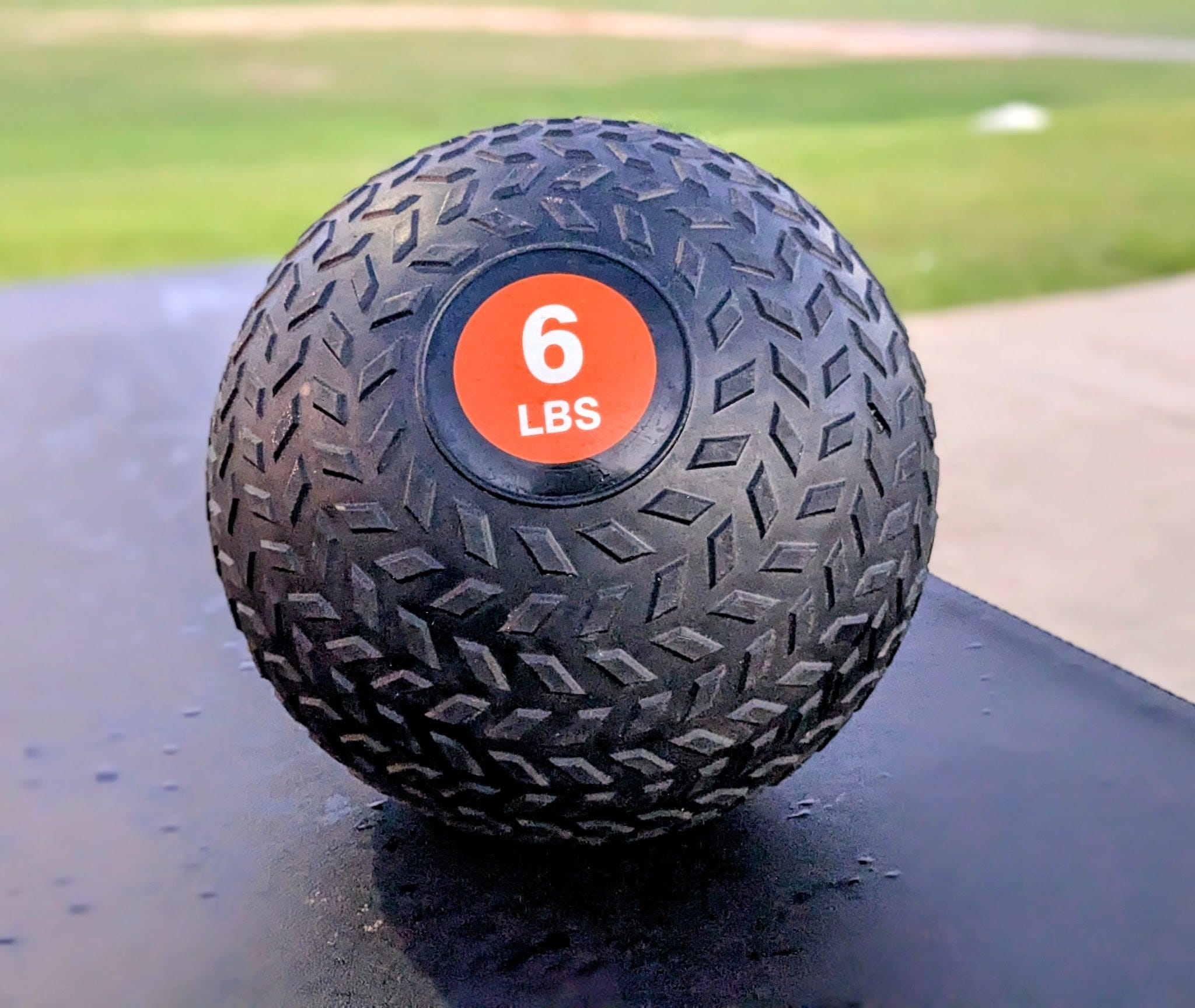
The six-pound ball never touches the ground.
Circle up and do squats while passing or tossing the six from man to man. Take the ball with you on the team run, making sure the lead man always has it. Each time a new man reaches the front, he takes the six from the previous leader.
You can also use the six-pounder for a game of Hooverball.
Discussion
When has someone had your six? Think about a time when someone pulled you forward or really had your back during a difficult situation.
How do you watch the six of your friends? What about the people in your church?
Isaiah says, “the glory of the LORD shall be your rear guard.” What does it mean to move forward knowing God is behind you? How does knowing God has your six free you for greater spiritual movement?
What past regret are you allowing to leave you spiritually exposed?
Isaiah 58 confronts the problem of improper fasting. Consider doing a group fast, but make sure everyone has considered any medical or dietary limitations beforehand. Break the fast over a shared meal, and leave a generous tip for the wait staff at the restaurant.
Study

10. The Wake-Up Call
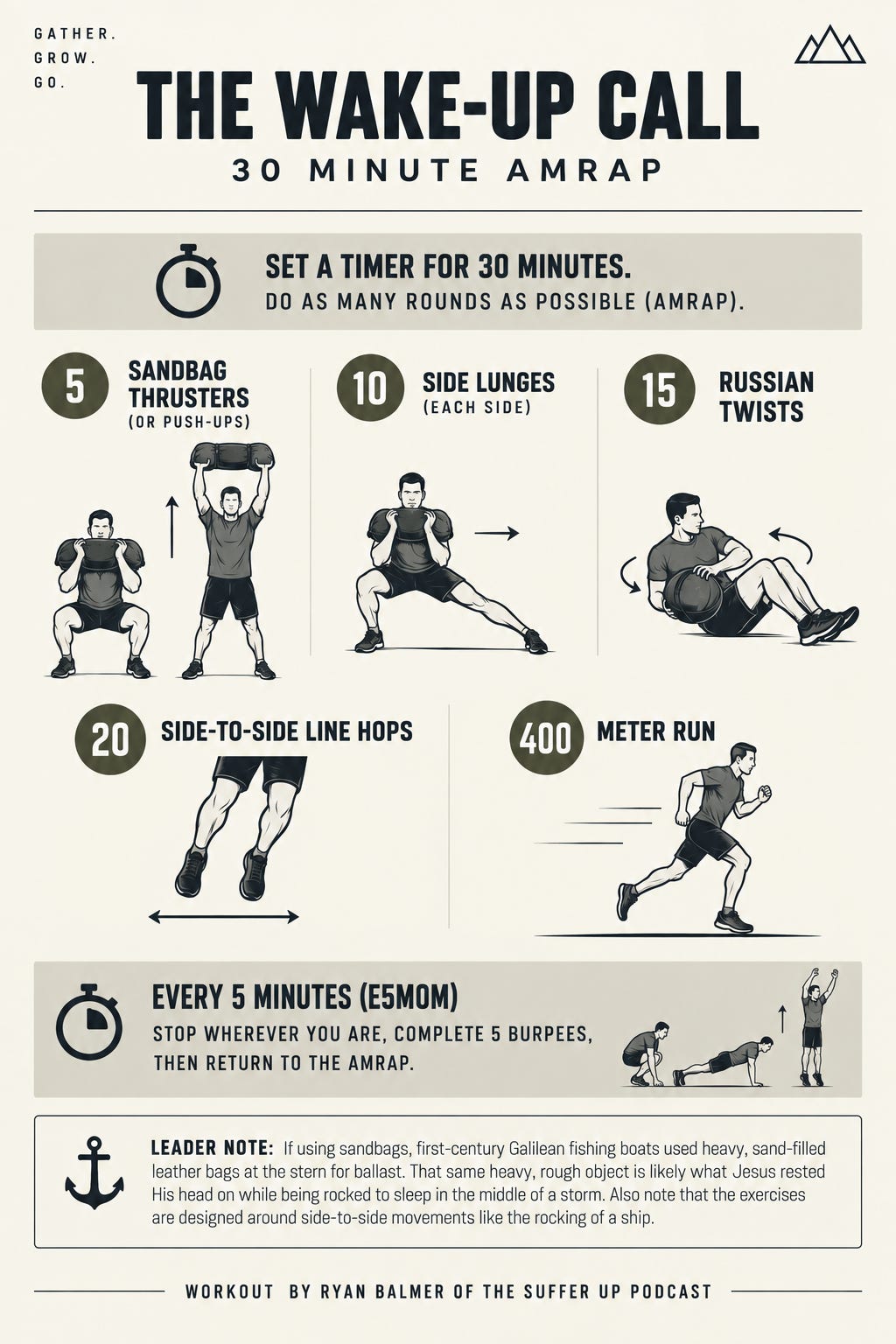
Set a timer for 30 minutes. Do as many rounds as possible (AMRAP).
5 sandbag thrusters (or push-ups)
10 side lunges (each side)
15 Russian twists
20 side-to-side line hops
400-meter run
Every 5 minutes (E5MOM): Stop wherever you are and complete 5 burpees, then return to the AMRAP.
Leader Note: If using sandbags, mention that first-century Galilean fishing boats used heavy, sand-filled leather bags at the stern for ballast. That same heavy, rough object is likely what Jesus rested His head on while being rocked to sleep in the middle of a storm. Also note that the exercises are designed around side-to-side movements like the rocking of a ship.
Discussion
(Ice Breaker) What’s the best sleep you’ve ever had?
What was your wake-up call to follow Jesus?
If a skeptical person asked why you put your faith in Jesus, what would you tell them? Why is Jesus real?
How does Jesus sleeping on this ship help you see HIm as fully man, and fully God.
Study

11. Iron Sharpens Iron
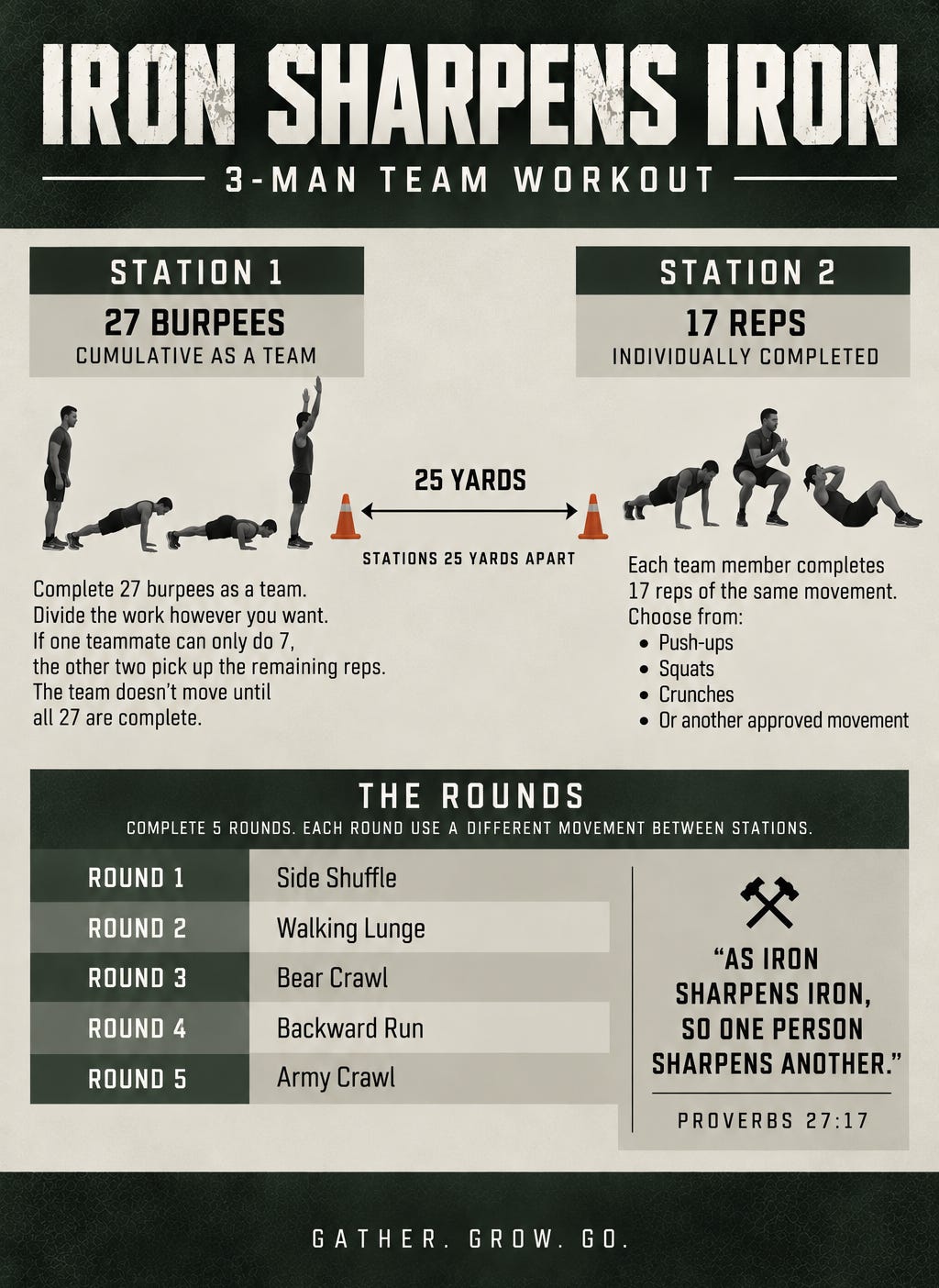
Grind through this three-man event. Modify and adjust as needed. The key is team movement—and friction.
Discussion
The Bible repeatedly warns against “whitewashing” over sin. Is there an area of your life where you’ve been tempted to put a little cover-up paint?
How well do you receive constructive criticism?
If you saw a spiritual brother engaging in dangerous behavior, how would you handle it?
Read Colossians 3:5–8. How can you put sin to death in your life? What spiritual disciplines do you use—or want to use—that lead to mortification?
