

“I think we missed something with this Nehemiah series.”
A friend called me with this blunt assessment a few hours before the sixth and final installment of a series through the Old Testament book of Nehemiah published here on Operation Muster Seed.
“We should have mentioned Ezra more,” he concluded.
Oof. Fair point.
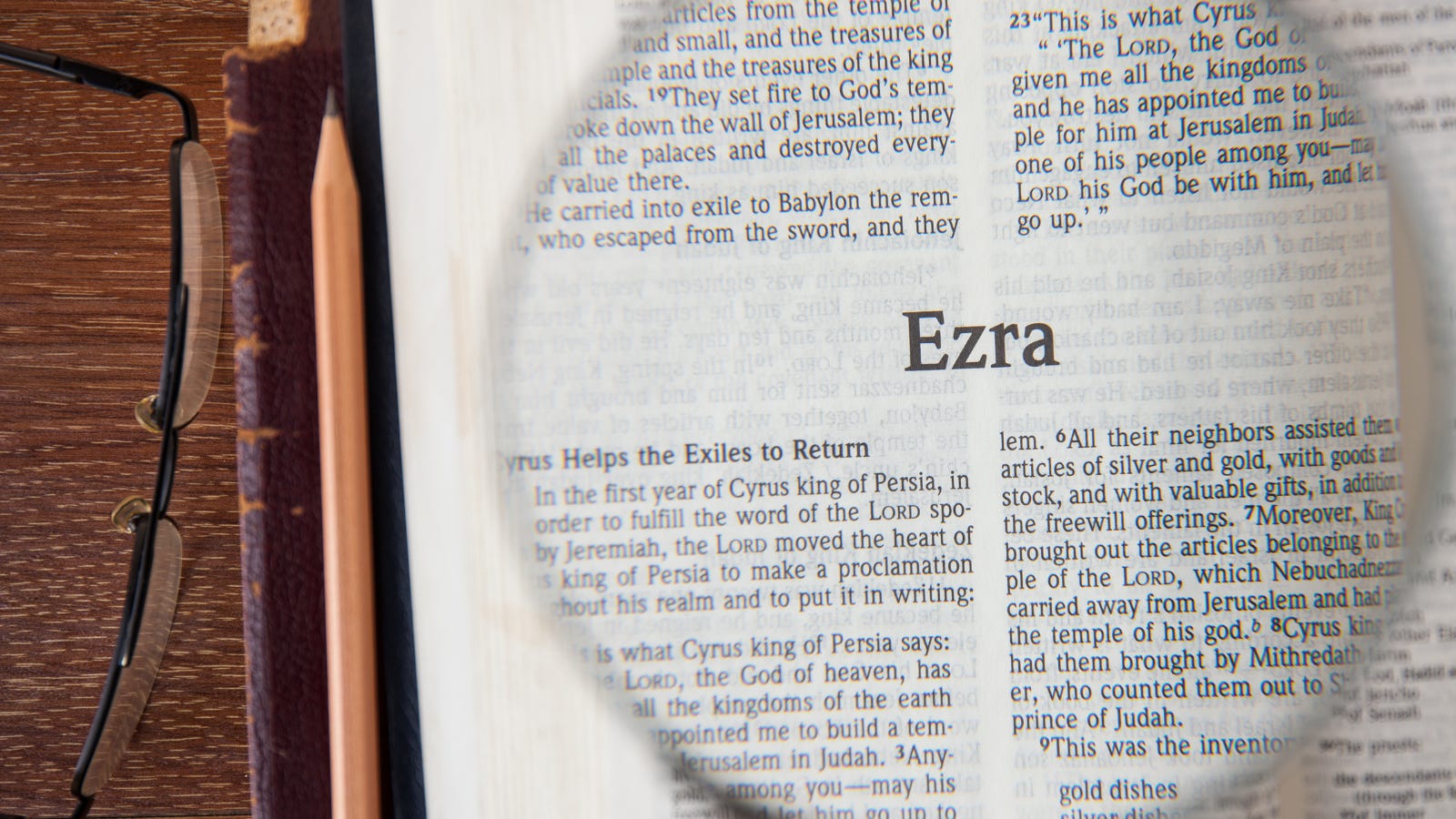
Ezra is the book in the modern Bible that precedes Nehemiah. But they aren’t merely two books sitting next to each other. Together, they document different angles of the same restoration story, showing how God fulfilled His promise to bring His people home from exile caused by their idolatry and sin.
Ezra documents the return to Jerusalem while Nehemiah focuses on rebuilding the city wall.
In the Hebrew Bible, Ezra and Nehemiah were originally treated as a single work.
But this isn’t the only link in the chain.
From Ezra, you see God’s sovereignty weaving together a tapestry of redemption that also demonstrates how the Bible is a cohesive narrative rather than 66 standalone books.
Ezra serves as a vital intersection in the biblical story, with kings, prophets, priests, and everyday servants navigating precisely according to God’s plan.
One verse summarizes this well:
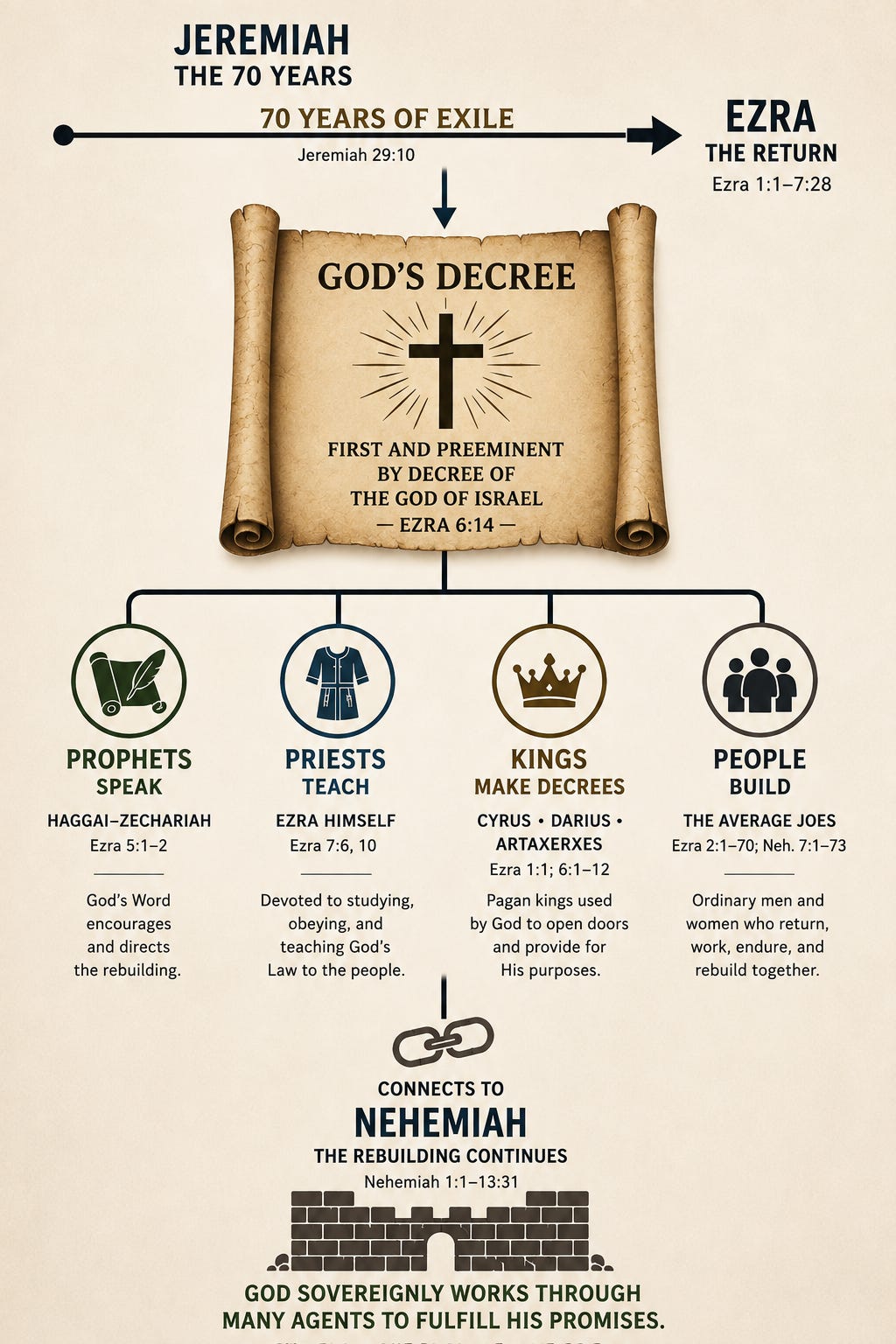
“And the elders of the Jews built and prospered through the prophesying of Haggai the prophet and Zechariah the son of Iddo. They finished their building by decree of the God of Israel and by decree of Cyrus and Darius and Artaxerxes king of Persia.” — Ezra 6:14
Notice whose decree is first and preeminent — God. Then consider the agents God uses throughout this story to carry out His divine decree:
1. Kings
Three Persian kings figure prominently in Ezra. Despite being pagan rulers, God uses them according to His own purpose.
Those anxious about the modern political climate should find comfort in this fact.
The book of Ezra opens with Cyrus authorizing the return to Jerusalem in his first year of reign. His decree resurfaces in Ezra 5 after opposition halts progress on rebuilding the temple. God is sovereign over all these circumstances, having “stirred up the spirit” of Cyrus at the very start of the book.
All of this happens according to a remarkably precise timeline. Cyrus’ decree lines up with Jeremiah’s prophecy that the Babylonian exile would end after 70 years (Jeremiah 29:10).
2. Prophets
Jeremiah is the first prophet mentioned in Ezra’s opening. Haggai and Zechariah are then introduced in chapter 5.
These prophets are instrumental in the Old Testament because God repeatedly used prophets to speak His Word directly to His people (Hebrews 1:1).
Modern readers can look at these three books and see how deeply they intertwine with the Ezra-Nehemiah narrative—and how they point forward to Jesus.
The Haggai-Zechariah duo offers a compelling one-two punch on the behind-the-scenes work of Jerusalem’s restoration. As Pastor David Guzik writes in his Enduring Word commentary:
“If all we had was Haggai to go by, we might conclude that all God was really interested in was the temple. Zechariah gives the rest of the story, and shows how God is interested in lives, not only buildings.”
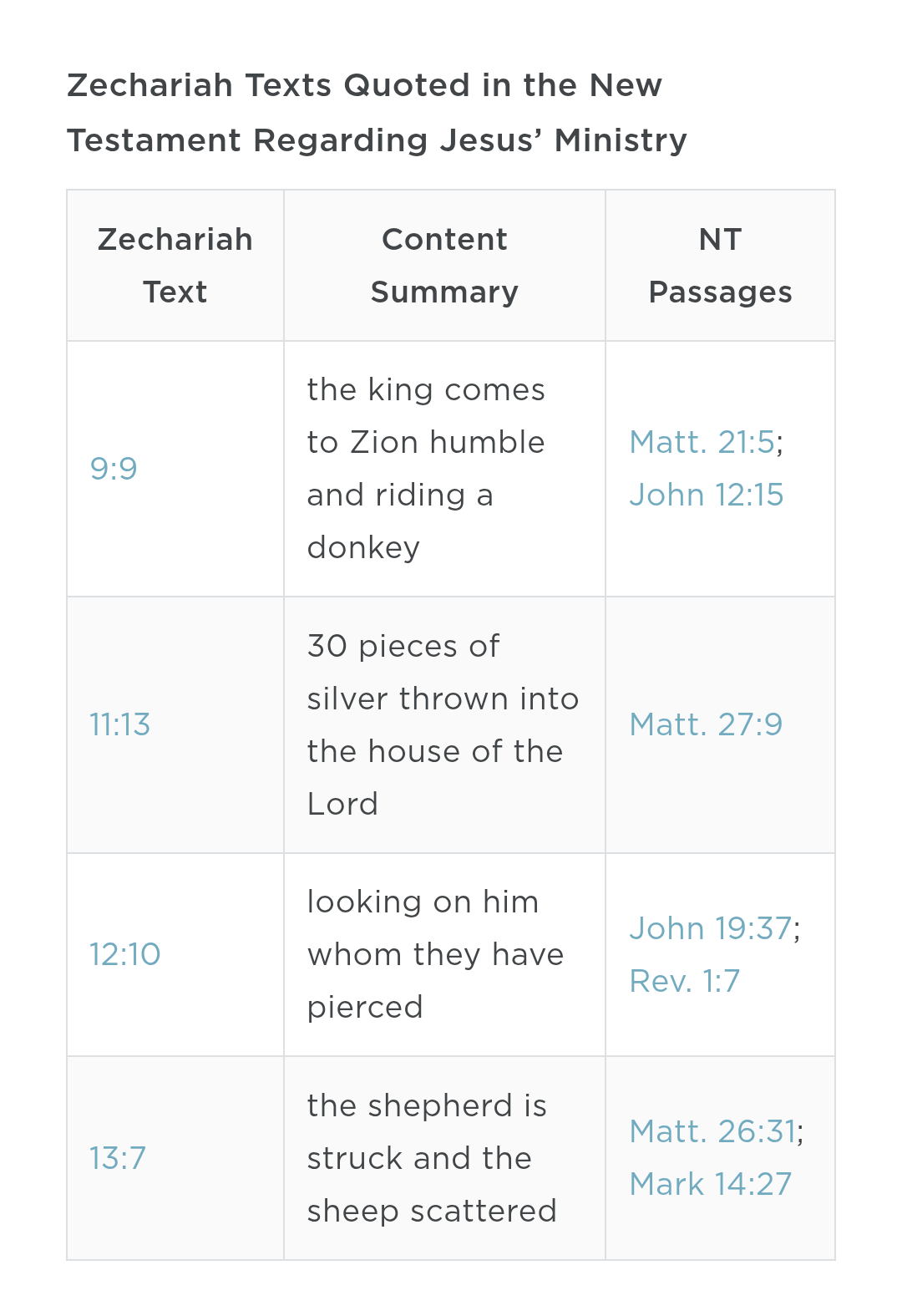
Zechariah’s work contains some of the most prominent Messianic prophecies in the Old Testament, including Jesus’ triumphal entry on Palm Sunday and His side being pierced on the cross.
This demonstrates that while God was blessing the earthly reconstruction of Jerusalem, He always maintained His ultimate focus on establishing Christ’s eternal, heavenly kingdom.
3. Priests
The titular character of Ezra doesn’t arrive until chapter seven, but his role and reputation in leading the people in worship through God’s word is paramount.
The centrality of Scripture plays out directly in the narrative of Ezra.
We not only see the fulfillment of Jeremiah and Zechariah’s words, but we also see the practical role of scripture in Jerusalem’s restoration through the work of Ezra and those entrusted as priests.
Scripture is the glue holding the restoration together, and Ezra’s commitment to knowing, obeying, and teaching it was crucial in making it stick.
4. The People
God didn’t only use prophets, priests, and kings.
Ezra 2 and Nehemiah 7 contain nearly identical lists of the pioneers who returned from exile to reestablish Jerusalem.
One of the key leaders was Zerubbabel, mentioned as a leader of the exiles in Ezra, identified as governor of Judah in Haggai, addressed by the prophet Zechariah, and—most importantly—a descendant of King David who appears in Jesus’ genealogies in Matthew 1 and Luke 3.
Zerubbabel is declared to be like God’s signet ring (Haggai 2:23), reversing the judgment once pronounced on the kings of Judah (Jeremiah 22:24). The image points forward to Christ, who is the exact imprint of God’s nature (Hebrews 1:3).
Connecting the Pieces
All the links in the Ezra-Nehemiah narrative make it difficult to not trust God’s Word.
Jeremiah sets the timeline that leads to Ezra.
Ezra connects to Nehemiah.
Haggai and Zechariah speak into the rebuilding and ultimate restoration through Jesus.
Kings make decrees, but God is sovereign.
Priests teach God’s Word.
Ordinary people build.
And, through all of it, God accomplishes exactly what He said He would.
That’s the story of Ezra-Nehemiah.
And, really, that’s the story of Scripture.
God keeps His promises.
Thank goodness for friends who call and tell you to pick up your Bible and keep reading so you don’t miss these links.


Thank you for sharing this, brother. I really appreciated the reminder that sometimes there are connections and details in Scripture that we can easily overlook, but when we slow down and study carefully, we begin to see how beautifully God’s Word fits together. It reminds me of 2 Timothy 2:15, Study to shew thyself approved unto God, a workman that needeth not to be ashamed, rightly dividing the word of truth.” The more we search the Scriptures, the more we recognize the wisdom and consistency of God’s redemptive plan. Jesus Himself showed His disciples how the Scriptures pointed to Him. In Luke 24:27, beginning at Moses and all the prophets, He explained the things concerning Himself throughout the Scriptures. That is such a powerful reminder that the Bible is not a collection of disconnected stories, but one great story of God’s work to redeem humanity through Christ. I also think about Proverbs 25:2, It is the glory of God to conceal a thing: but the honour of kings is to search out a matter. There is something beautiful about slowing down, asking questions, comparing Scripture with Scripture, and discovering truths that we may have missed before. Acts 17:11 gives us the example of the Bereans who searched the Scriptures daily to see whether the things they were taught were true. May God give us that same hunger for His Word and the humility to keep learning. Sometimes the smallest details can help us see the bigger picture of God’s faithfulness. John 5:39 says, Search the scriptures; for in them ye think ye have eternal life: and they are they which testify of me May our study never be only about gaining knowledge, but about knowing Christ more deeply and becoming more faithful in our walk with Him. Thank you again for sharing this study, brother. May the Lord continue to open our eyes to the treasures in His Word and give us wisdom to recognize the connections we almost missed. Amen.